Soil To Bowl Journal
What Is A2 Cow Ghee? Meaning, Benefits and How It Differs from Regular Ghee
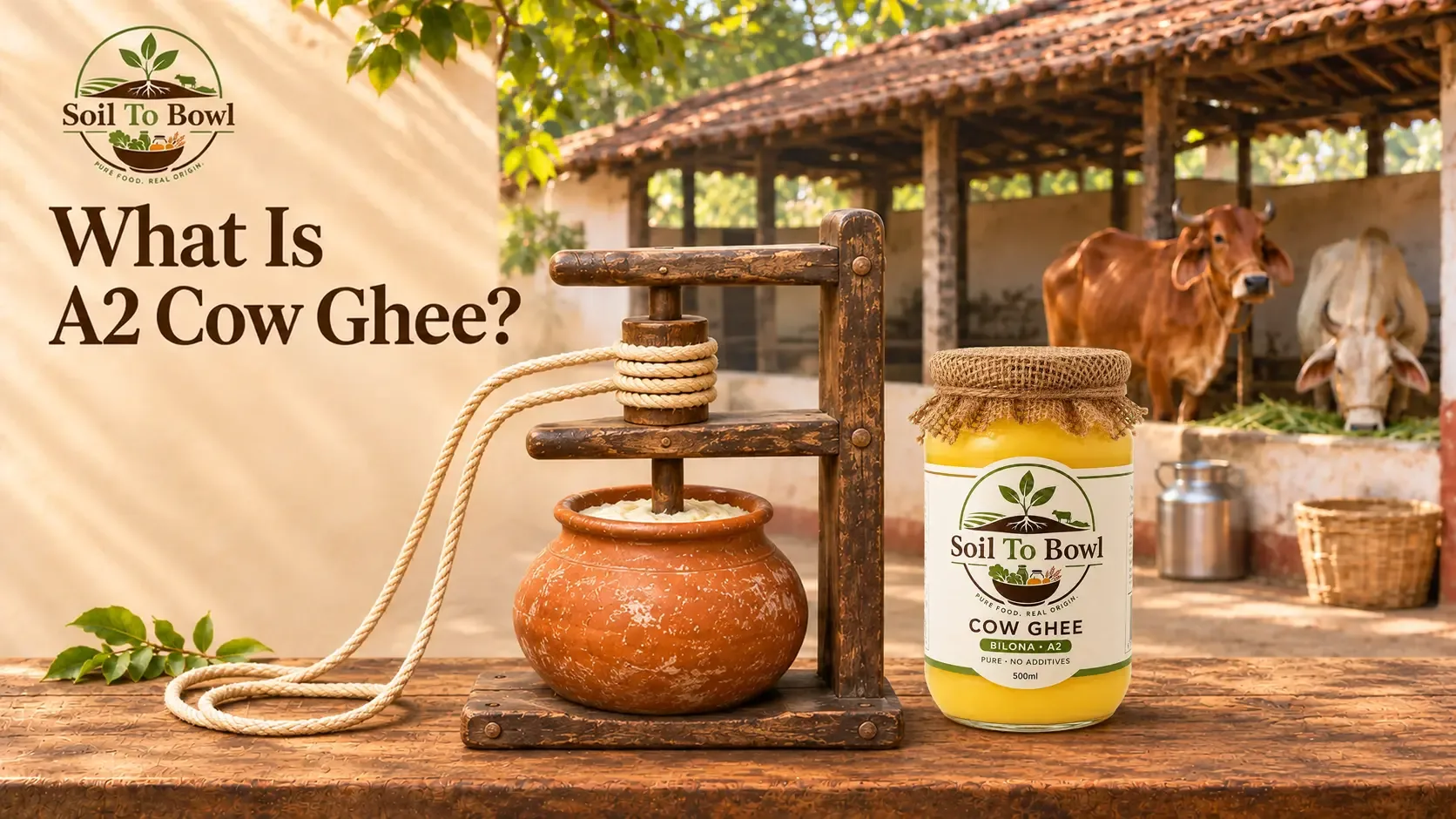
**A2 cow ghee is clarified butter made from A2 cow milk.** The “A2” refers to beta-casein, a protein in the milk used to make it. If the jar also says “bilona”, that tells you how it was made. The milk was set into dahi, churned to separate the makkhan, and the makkhan was heated and strained into ghee.
If you’re choosing between two jars for your kitchen, the differences you can actually taste start with the aroma and flavour. Here’s what to look for on the label, what the bilona method changes and when a smaller jar is worth trying first.
What does A2 mean in A2 cow ghee?
Beta-casein is one of the proteins in cow’s milk. A1 and A2 are variants of that protein. In the usual A1/A2 classification, cows with two copies of the A2 variant (A2A2) produce A2 beta-casein without the A1 variant. Cows with one copy of each (A1A2) produce both. [ICAR’s explanation of A1 and A2 milk](https://epubs.icar.org.in/index.php/IndFarm/article/view/116649)
Ghee is mostly milk fat. During clarification, almost all the water and non-fat milk solids are removed. India’s food standard sets a minimum of 99.5% milk fat by weight for ghee. Think of “A2” on a ghee jar as a claim about the **starting milk**. The finished ghee is still a cooking fat. [FSSAI’s milk fat product standard](https://fssai.gov.in/upload/notifications/2021/12/61ce91bf0f10eGazettte_Notification_Ghee_Milk_31_12_2021.pdf)
Which Indian desi cow breeds produce A2 milk?
A2 milk is common in several indigenous Indian dairy breeds. Studies have found the **A2A2 genotype in Gir, Sahiwal, Rathi, Tharparkar and Red Sindhi cattle**. In one study of Mumbai dairy farms, milk from all 49 Gir cows sampled had the A2 beta-casein variant without A1. A separate study found that 87% of the 306 Sahiwal cows sampled were A2A2. These figures describe the animals the researchers studied. [ICAR–NBAGR researchers’ review of Indian cattle](https://ispgr.nbpgr.ernet.in/SpecialVol/03/09-Monika%20Sodhi-Rev.pdf) · [Mumbai milk study in the Indian Journal of Dairy Science](https://epubs.icar.org.in/index.php/IJDS/article/view/170843) · [Sahiwal study in the National Digital Library of India](https://www.ndl.iitkgp.ac.in/re_document/arccjournals/arccjournals/b_3493)
A2A2 also occurs in some crossbred cows. The same Mumbai study found it in some Jersey and Holstein Friesian crossbreds. So when you see “desi cow” on an A2 cow ghee label, the breed tells you something about the milk’s origin. To check the A2 claim, ask how the producer verifies the source herd’s A2A2 status and keeps that milk separate before making the ghee. [Mumbai study results, Table 1](https://epubs.icar.org.in/index.php/IJDS/article/download/170843/62443/488024)
How is A2 bilona cow ghee made?
The bilona method begins the same way as a bowl of homemade dahi. The extra steps come after the curd sets.
1. **Set the milk into dahi.** The milk is cultured and left to set.
2. **Churn the dahi.** Churning separates the makkhan from the liquid buttermilk.
3. **Heat the makkhan.** The butter is heated so the moisture cooks off and the remaining milk solids separate from the fat.
4. **Strain and cool.** The clarified fat is strained and cooled before it goes into the jar.
At Soil to Bowl, we hand-churn the cultured curd to separate the makkhan and cook it slowly in small batches over a controlled wood fire. Other dairies can make cow ghee by heating separated cream or by clarifying creamery butter. These are different routes to the same kind of cooking fat, and the route can influence how the finished ghee smells and tastes. [Soil to Bowl’s bilona process](https://www.soiltobowl.com/dairy-products/a2-desi-pure-cow-ghee) · [Indian Journal of Dairy Science on ghee preparation methods](https://epubs.icar.org.in/index.php/IJDS/article/view/123949)
A2 cow ghee vs regular cow ghee
| What to compare | A2 bilona cow ghee | Regular cow ghee |
| Milk source | The maker specifies cow milk sourced for A2 beta-casein. | The label identifies cow milk as the source. It may leave the beta-casein type unspecified. |
| Preparation | Milk is cultured into dahi, churned for makkhan and clarified. | The method depends on the maker. Examples include direct cream and creamery butter. |
| Flavour and texture | Culturing and heating can give it a pronounced cooked-butter aroma. The texture can vary with temperature. | Flavour and texture vary with the maker’s process and how the ghee is cooled and stored. |
| Nutrition | Primarily milk fat. | Primarily milk fat. |
| Price | Sourcing, extra handling and smaller batches can affect the price. | The price depends on the maker, pack size and production method. |
“Desi ghee” is a broad term you’ll see on both cow and buffalo ghee. “Gir cow ghee” names the breed the milk came from. And a jar labelled “A2” could be made from cream, while a jar labelled “bilona” tells you the process and may leave the milk’s beta-casein type unspecified.
A2 cow ghee benefits and uses in Indian cooking
The benefit you can judge for yourself is flavour. Try a little on a hot roti or a plain bowl of dal. Those dishes make it easier to notice the aroma than a heavily spiced curry does. If you enjoy the taste, here are a few ways to use it:
- **Dal or kadhi.** Warm a little ghee, let the jeera sizzle and pour the tadka over just before serving.
- **Khichdi or bajra roti.** Add it at the table while the food is still hot.
- **Sooji halwa or besan laddoos.** Use it to roast the sooji or besan so the ghee’s aroma carries through the dish.
- **Parathas.** Brush on a little after cooking if you want to taste it more clearly.
Nutritionally, ghee is a concentrated source of fat and contains saturated fat. The ICMR–National Institute of Nutrition advises limiting fats high in saturated fat, including ghee. Research about beta-casein in milk does not establish a digestive or weight-loss benefit for the finished ghee. [ICMR–NIN’s Dietary Guidelines for Indians](https://www.nin.res.in/dietaryguidelines/pdfjs/locale/DGI07052024P.pdf) · [ICAR’s discussion of the evidence on A1 and A2 milk](https://epubs.icar.org.in/index.php/IndFarm/article/view/116649)
How to choose pure A2 cow ghee in India
Start with the back of the jar. The front usually tells you the product name. The back gives you details you can use to compare it with another jar.
1. **Check who made it.** Look for the maker’s details, FSSAI licence or registration number, batch code, date marking and net quantity.
2. **Ask about the milk.** If you’re paying extra for A2 sourcing or a named breed, ask what records or testing support that claim.
3. **Ask how it was made.** If you want bilona ghee, look for a description that goes from dahi to churned makkhan to ghee.
4. **Treat taste and texture as preferences.** A *danedar* or grainy texture can be appealing, but colour, aroma and how fast ghee melts cannot verify milk sourcing or purity. If a seller shares a lab report, check which batch it covers and what the lab actually tested.
[FSSAI’s labelling and display guidance](https://www.fssai.gov.in/food-law/regulations/amendments/labelling-display) · [Indian Journal of Dairy Science on laboratory detection of vegetable fat in ghee](https://epubs.icar.org.in/index.php/IJDS/article/download/75684/33651/205163)
Why is A2 bilona cow ghee often more expensive?
Setting the dahi, churning it and clarifying the makkhan take time. The cost of sourcing milk, making smaller batches and packing the ghee can also affect what you pay. A premium price alone cannot tell you where the milk came from or how the jar was made.
When checking **A2 cow ghee prices in India**, compare the same unit. For example, a ₹1,000 jar containing 500 ml works out to ₹2,000 per litre. If one pack is in grams and the other is in millilitres, compare products with a common stated unit. Include delivery charges if they apply. A small trial pack is a practical way to see whether you enjoy the flavour before buying a larger jar.
How should you store bilona ghee?
Follow the storage instructions and date marking on the jar. Keep it tightly closed in a cool, dry spot away from sunlight and use a clean, dry spoon. The same ghee can look more liquid in a warm kitchen and firmer or grainier when the weather cools.
Frequently asked questions
Is all A2 cow ghee made using the bilona method?
No. A2 describes the milk source. Bilona describes the curd-churning method. Look for both details if both matter to you.
Is A2 cow ghee the same as Gir cow ghee?
Gir names a breed of cow. A2 refers to the beta-casein variant in the source milk. A producer can use both terms when it can substantiate both claims.
Does “A2” mean the ghee is lactose-free?
A2 refers to a milk protein variant. Lactose is a milk sugar. The A2 label by itself does not establish a product’s lactose content. Ghee is dairy-derived.
Which ghee should I buy for everyday cooking?
Start with the dishes you cook most. If you want a ghee whose aroma comes through on hot roti, dal or khichdi, try a small jar of bilona ghee. If you use ghee in larger quantities for sweets or batch cooking, compare the cost per litre and choose a flavour you enjoy at that price.
Try Soil to Bowl A2 Bilona Cow Ghee
If you’re in Gurugram (Gurgaon) or Rewari and want to taste it before buying a bigger jar, we offer a 100 ml trial pack in selected delivery areas. Visit the [Soil to Bowl A2 Desi Cow Ghee page](https://www.soiltobowl.com/dairy-products/a2-desi-pure-cow-ghee) to check current pack sizes, pricing and delivery availability for your location.